
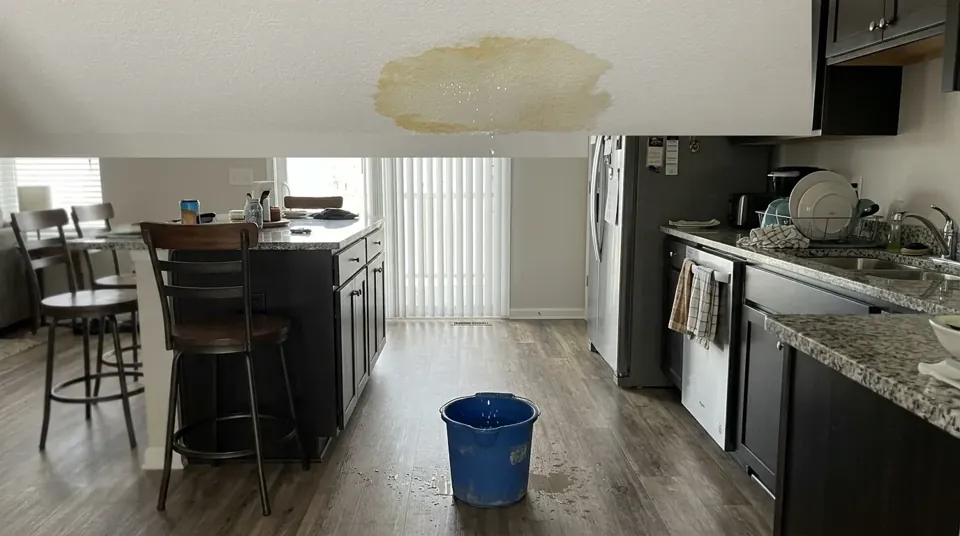
Who Pays for Water Damage? Landlord, HOA, Neighbor or City
In most cases, each owner’s insurance pays for the part of the property that owner insures. A landlord’s policy covers the building, and a renter’s policy covers the renter’s belongings (Texas Department of Insurance). The person who caused the leak may owe money too, but that usually gets sorted out after the repairs, often between insurance companies.
This guide covers Texas rules for renters, landlords, condo owners, upstairs neighbors, City lines and home purchases. It is general information, not legal advice. Your lease, your association’s documents and your policy decide the details. For a dispute, talk to a Texas attorney or a free legal aid office.
Plano Water Damage Restoration is a referral service. When you call, we connect you with an independent local restoration company. We don’t do the work, and we don’t decide or negotiate who pays.
Water still coming in? Stop it first if you can. Then call (972) 433-0517. The line answers 24/7.
Who is responsible for fixing water damage, the insurance company or the homeowner?
The property owner is responsible for the repairs. Insurance pays the owner back for covered damage, minus the deductible. TDI also advises making temporary repairs to protect your home and belongings before the adjuster visits (TDI Home insurance guide). Stopping the water and starting drying are that kind of step.
Here is the usual starting point. Every case depends on the cause, the lease or governing documents, and the policies involved.
| Situation | Usually pays for the building | Usually pays for belongings | First call |
|---|---|---|---|
| Renter in a house or apartment | Landlord and the landlord’s insurer | Renter’s own renters insurance | Landlord or property manager, in writing |
| Condo unit owner | Your HO-6 policy and the HOA master policy, split by the association’s documents | Your HO-6 policy | HOA or management company, and your insurer |
| Leak from an upstairs unit or neighbor | Your insurer first, then it may seek repayment | Your own policy | Your insurer, then the neighbor and HOA |
| City water or sewer main | Your insurer first. A claim against the City may be possible | Your own policy | City of Plano emergency line, then your insurer |
| Damage found before buying a home | Negotiated between buyer and seller | Not applicable | Your agent and inspector |
Whatever the situation, the same evidence helps: dated photos, a written record of who you told and when, and moisture readings. What a homeowners policy covers, deadlines and deductibles are explained in our Texas water damage insurance guide.
There’s a leak in my rental. What do I do first?
Protect yourself and your things, take photos, then tell your landlord in writing. Under Texas law, the notice must be in writing if your lease is written and requires written notice (Property Code §92.052(d)). Written notice is a good habit either way.
- Stop the water if you safely can. Turn off the fixture’s valve or the main shutoff. If you can’t find it, call the landlord’s emergency line.
- Stay clear of electricity. Don’t walk through water near outlets or cords.
- Take photos and video of the leak, the wet rooms and your damaged belongings.
- Notify the landlord or property manager at the place where you normally pay rent. Keep a copy, and note the date and time.
- Move belongings out of the wet area and dry what you can.
- Call your renters insurance company to report damage to your belongings.
Don’t wait on drying. The EPA advises drying wet materials within 24 to 48 hours to prevent mold growth. If the landlord is slow to respond, say so in a second written notice. Mold rules for tenants are covered on our mold remediation page.
Renting? Tell your landlord in writing first. If your landlord or property manager asks you to arrange the cleanup, call (972) 433-0517.

What are a Texas landlord’s repair obligations for water leaks?
A Texas landlord must make a diligent effort to repair a condition that materially affects the physical health or safety of an ordinary tenant. That duty starts once the tenant gives notice and is current on rent (Property Code §92.052).
A few limits apply:
- Notice goes to the right place. It goes to the person or place where rent is normally paid.
- Rent must be current when you give notice.
- Tenant-caused damage is different. The landlord doesn’t have to repair a condition caused by the tenant, a household member or a guest. Normal wear and tear is the exception (§92.052(b)).
A burst pipe, sewage coming up through a drain or a ceiling leak over a bedroom can all affect health or safety. A slow drip under a sink may not. The lease can add more duties for the landlord, so read it.
My apartment AC is leaking through the ceiling. How long does my landlord have to fix it?
Texas law presumes that seven days is a reasonable time to repair, but that presumption can be rebutted (Property Code §92.056(d)). The severity of the problem, and whether parts, labor and utilities are available, can make the reasonable time shorter or longer.
To use the tenant remedies, the law generally expects two steps. First, give notice to repair. Then give a second written notice after a reasonable time, unless your first notice went by certified mail or another trackable delivery service (§92.056(b)).
If the landlord still doesn’t make a diligent effort, a tenant may have these options (§92.056(e)):
- end the lease;
- have the problem repaired and deduct the cost from rent, within limits;
- or ask a court for remedies.
Repair-and-deduct has strict rules. For sewage backing up or flooding from broken pipes inside the home, the repair can be made right after the required notice. Each deduction is capped at one month’s rent or $500, whichever is greater (§92.0561). A court can order repairs, reduce rent, award a civil penalty of one month’s rent plus $500, and award actual damages (§92.0563). Read the statutes or ask a lawyer before you use any of these.
A leaking AC is often a clogged condensate drain line. Our ceiling water damage page explains what to do about the water while you wait.
What are my rights if my apartment is still damaged weeks after a storm or freeze?
For an insured casualty loss, the landlord’s repair period doesn’t start until the landlord receives the insurance money (Property Code §92.054(a)). That’s why repairs after a big storm or freeze can drag on.
You still have options:
- Home totally unusable: if you didn’t cause the damage, you or the landlord can end the lease with written notice before repairs are finished. You get a prorated rent refund from the day you move out (§92.054(b)).
- Home partly unusable: you may get a rent reduction for the part you can’t use, but only by a county or district court judgment. A written lease can set a different rule (§92.054(c)).
Keep paying rent unless a lawyer tells you otherwise, since most tenant remedies require that you are not behind on rent.
Does renters insurance cover water damage?
Usually yes, for your belongings, when the water damage is sudden and accidental, like a burst pipe or an overflowing toilet. Renters insurance doesn’t cover the building. The landlord’s insurance pays to repair the structure, not your belongings (TDI).
What a renters policy usually includes (TDI):
- Personal property: your furniture, clothes and electronics.
- Additional living expenses (ALE): some hotel and living costs if a covered loss makes your home unlivable. TDI says most home, renters and condo policies pay some of these costs.
- Personal liability: costs for injuries or damage you’re legally responsible for.
Most renters policies don’t cover flood damage, which needs a separate flood policy (TDI). Check your policy for water backup coverage too, since water from a drain or sewer line is often treated differently.
Does my landlord have to pay for my belongings damaged in a leak?
Usually your renters insurance pays for your belongings, not the landlord. The landlord’s policy covers the building (TDI). If you believe the landlord ignored a proper repair notice, Texas law lets a court award a tenant’s actual damages (Property Code §92.0563). That is a question for a lawyer or a legal aid office.
Our rental had a leak that wasn’t our fault. Whose insurance covers our things?
Your own renters insurance usually pays for your belongings first, minus your deductible. If someone else caused the leak, your insurer may try to recover what it paid from that person’s insurer. This is called subrogation. Without renters insurance, you would need to ask the landlord or the person at fault directly.
A large loss right after moving in follows the same steps. Report it in writing, document everything and open a renters claim. Ask the landlord for its insurer’s claim number. If you’re stuck, the TDI Consumer Help Line is 800-252-3439.
My apartment flooded from the unit upstairs, and the landlord won’t pay for a hotel. Who covers it?
Usually your own renters policy, through additional living expenses, if a covered loss made the home unlivable (TDI). Texas repair law doesn’t list a hotel among a tenant’s standard remedies (Property Code §92.056(e)). Your lease may say more.
If the home is totally unusable and you didn’t cause the damage, you can end the lease by written notice (§92.054(b)). Keep every hotel and meal receipt. Hotel coverage basics are on our Texas water damage insurance guide.
My AC leaked into the unit below, and the downstairs owner wants more money from me. Am I responsible?
It depends on the cause and on your lease. Report the demand to your renters insurance company before you pay anything or admit fault. Renters liability coverage pays for damage you’re legally responsible for (TDI).
Ask your landlord who maintains the AC and its drain line under your lease. If it’s the landlord’s equipment and you reported problems, keep copies of those reports. Put your answers to the downstairs owner in writing.
Managing rental units? One call to (972) 433-0517 reaches a local restoration company that documents the damage for owners and insurers.
Who is responsible for water damage in a condo: HO-6 or the HOA master policy?
The association’s declaration decides the line, and Texas law sets the minimum. The association must insure the common elements. Where units sit above or below each other, the association’s policy must also cover the units. It doesn’t have to cover upgrades owners added (Property Code §82.111(b)).
That rule covers Texas condos created since 1994. It also applies to older condos, but an older condo’s own declaration can still control (Property Code §82.002). Your HO-6 condo policy fills the gaps:
- Your belongings.
- The parts of the unit your association’s rules make your responsibility, such as flooring, cabinets or upgrades you added. For example, one TDI-approved unit-owner form covers property that’s the owner’s responsibility under the association’s rules (TDI Commissioner’s Order 02-0523).
- Additional living expenses and personal liability (TDI).
If both policies cover the same damage, the association’s policy is primary (§82.111). Ask the HOA for a copy of the declaration and the master policy’s declarations page. Give both to your insurance agent.
Townhome owners should check too. Some HOAs insure the exteriors, and some don’t. Your policy needs to match.
What should I expect when the HOA sends an insurance adjuster?
The HOA’s adjuster works for the master policy’s insurer, not for you. That adjuster decides what the master policy pays for the building. Your own HO-6 insurer looks at your belongings and the parts of the unit that are yours.
- Tell your own insurer about the damage right away, even if you think the HOA will pay.
- Take your own photos before anyone removes materials.
- Ask for a written copy of the repair scope for your unit.
- Keep drying records and receipts. Ask any restoration company for daily moisture readings.
My upstairs neighbor’s AC leak caused mold in my condo walls, but my insurer says the walls are the HOA’s problem. Who pays?
Check the declaration’s definition of your unit. It says whether the drywall belongs to you or is a common element. If the walls are the association’s to insure, file the claim with the HOA in writing. Ask your insurer to put its position in writing too.
Mold adds a wrinkle. Many Texas policies don’t cover mold remediation, and the ones that do generally cap it (Texas Attorney General). If the two insurers disagree, the TDI Consumer Help Line can explain your options. In Texas, mold remediation of 25 contiguous square feet or more generally needs a TDLR-licensed company, as our mold remediation page explains.
The HOA fixed damage from an upstairs dishwasher but wants me to pay its huge deductible. Can it?
It depends on who caused the damage and on your documents. Texas law lets the association charge its deductible to an owner whose act or omission caused the damage. The same goes if the owner’s guest caused it (Property Code §82.111(l)). Otherwise, if the repair costs less than the deductible, whoever would normally be responsible for that repair pays (§82.111(j)). If it costs more, the governing documents decide who pays the deductible. If they’re silent, the board can decide by resolution. Without a resolution, it’s a common expense (§82.111(k)).
So if a neighbor’s dishwasher caused the leak, ask the HOA in writing which rule it relied on to bill you. Also check your HO-6 policy for loss assessment coverage. Limits can be low. One Texas form pays no more than $1,000 toward an assessment for the association’s deductible (Texas FAIR Plan endorsement HO-382, 2017).
Own a condo? Report the damage to the HOA and your insurer the same day. Then call (972) 433-0517 if your unit needs drying.
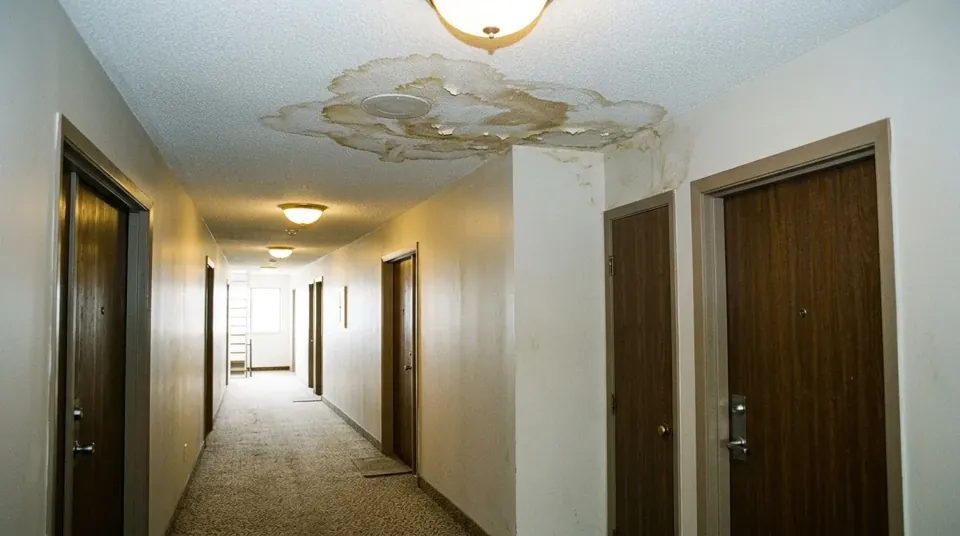
The upstairs neighbor caused water damage to my home. How do I get them to pay?
Start with your own insurance company, not the neighbor. Your insurer pays covered damage, minus your deductible. It can then try to recover its payment from the neighbor’s insurer, through a process called subrogation.
The neighbor’s liability coverage pays only if the neighbor is legally responsible for the damage (TDI). A sudden supply-line break with no warning may not be anyone’s fault. A tub left running is different.
- Tell the neighbor, and the HOA or landlord, in writing. Ask for their insurance company and policy number.
- Keep photos of the source, such as the failed hose or the overflow.
- Tell your insurer who you think caused it.
For an upstairs bathroom leak through your ceiling, see our ceiling water damage page for the first steps.
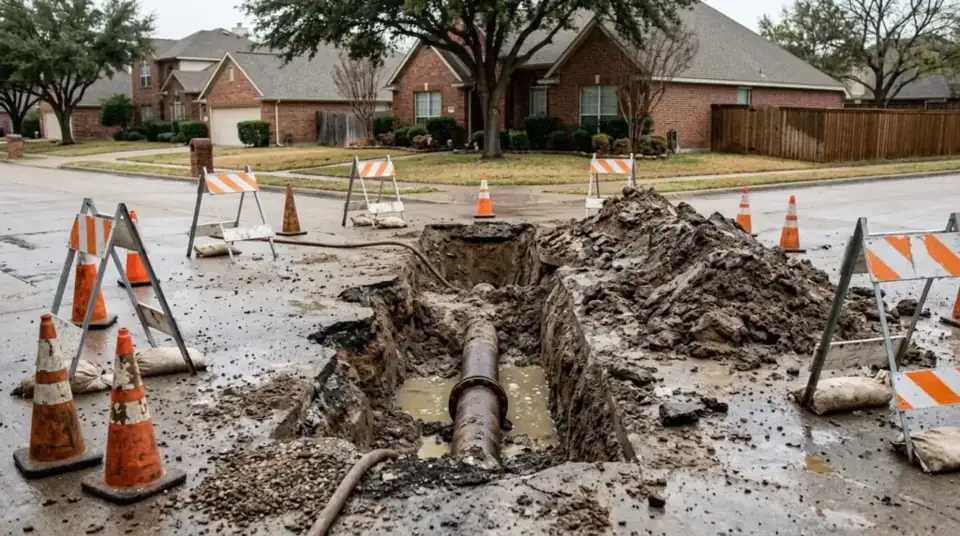
City water main or my private line: who pays?
In general, the City looks after its own mains, and owners look after the pipes on their property. Plano says the City does line locates only in the City right-of-way, not on private property (City of Plano).
For a water main break, contact the City of Plano. For a sewer backup, Plano says that if it happens inside your home, you’re responsible for the repair and cleanup (City of Plano). Our sewage cleanup page explains that rule.
If you believe a City main caused the damage, you can file a claim with the City. Article 11 of the Plano City Charter requires written notice within 6 months of the incident. City of Plano Risk Management answers questions at RiskInfo@plano.gov. The City decides that claim through its own process.
In the meantime, report the damage to your own insurer and start drying. We couldn’t find where City pipe ends and private pipe begins on plano.gov. Ask Public Works if it matters for your claim. A break inside your walls is covered on our burst pipe page.
If water damage shows up in a home inspection, who fixes it?
Before closing, it’s usually something the buyer and seller negotiate. Most Texas sellers of a single-family home must give the buyer a written disclosure notice, and it asks about past flooding (Property Code §5.008). If a buyer signs without getting that notice, the buyer may end the contract within seven days after receiving it.
Things to do as a buyer:
- Ask the seller for repair records, insurance claims and plumber reports for any water damage.
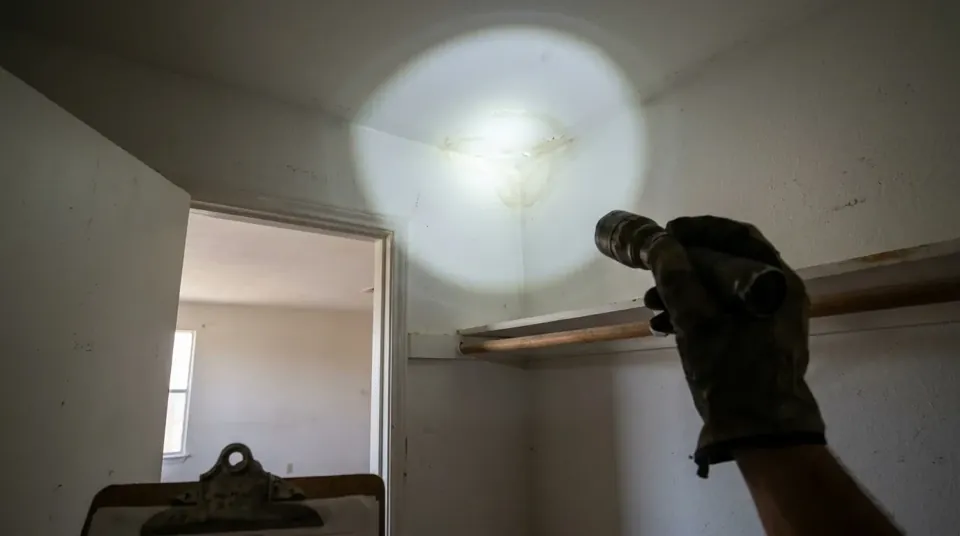
- Ask for a moisture check where the inspector found stains.
- Get a written estimate before you agree on a price cut or repair credit.
- Ask your insurance agent how the new policy treats damage that existed before you bought.
In an older home, a plumbing leak test can find a slab leak before you own it. See slab leak water damage.
A showing left my AC set wrong, and now there’s a ceiling leak. Who is responsible?
Start with your own homeowners insurance and fix the water problem now. If the damage is covered, your insurer pays you, then may seek repayment from whoever caused it (this is called subrogation). Tell the listing agent and broker in writing what happened and when.
Don’t wait for the blame question to settle before drying. Our what to do after water damage checklist covers the first hour.
Can I get the landlord or HOA to pay for the extra electricity from drying equipment?
Ask, in writing, whoever hired the restoration company. Drying equipment runs around the clock. Restoration estimates written in Xactimate, the estimating software many insurers use, can include an electricity charge based on the drying equipment used (Xactware).
Compare your electric bill during drying with the same month last year. Send both bills with your request. If the claim is under your own policy, give the bills to your adjuster. More on how equipment is billed is on our water damage restoration cost page.
Do renters need to worry about water damage?
Yes. In Plano, 43.1% of households rent (U.S. Census ACS 2020–2024). In Legacy and far north Plano (75024), about 62% of households rent. More than half of homes there are in buildings with five or more units. In those buildings, a leak in one unit can reach the units below.
The landlord’s policy won’t replace your things (TDI). A renters policy covers your belongings, some hotel costs and your liability if you damage a neighbor’s unit. Check what yours excludes before you need it.
Water damage where you live? Call (972) 433-0517
Stop the water, take photos and tell the right person in writing: your landlord, your HOA or your insurer. Then call (972) 433-0517 to reach an independent local restoration company. The line answers 24/7. See the areas we serve.
Call (972) 433-0517