
How to Hire a Water Damage Restoration Company in Texas
Water is on the floor and someone hands you a form to sign. This checklist covers what that form does, which promises Texas law forbids, and how to look up a company’s credentials in a few minutes.
Plano Water Damage Restoration is a referral service. When you call (972) 433-0517, we connect you with an independent local restoration company. We don’t do the work ourselves, so use this same checklist on the company you reach.
Can a restoration company require payment up front in Texas?
After a declared natural disaster, an out-of-area contractor can’t require any payment before work begins (Business & Commerce Code §58.003). Partial payments also can’t run ahead of the work done and materials delivered.
This rule, Chapter 58, has limits:
- It applies when the governor or a county judge has declared a disaster for a natural cause, such as flood, wind or storm (§58.001).
- It doesn’t apply to a contractor that has kept a physical business address in your county, or a neighboring county, for at least one year (§58.002).
- When it applies, the contract must say so in bold type of at least 10 points (§58.003).
A burst pipe in your own home usually isn’t part of a declared disaster, so Chapter 58 won’t apply. A big freeze can be the exception: in February 2021 the governor declared a disaster in all 254 Texas counties. Even then, never pay the full price before the work is done.
If a company knocked on your door and you signed at home, you may be able to cancel. Texas law generally gives you until midnight of the third business day after signing (Business & Commerce Code §601.051).
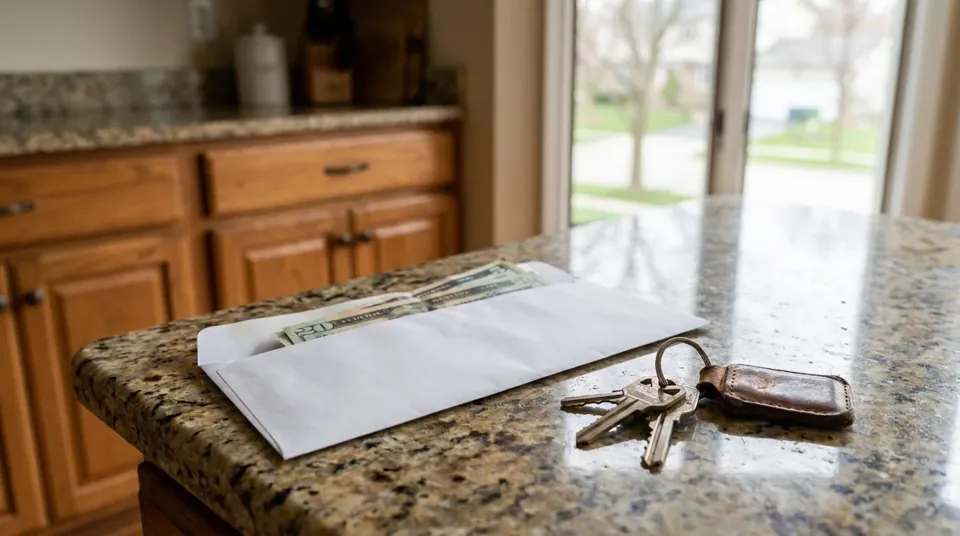
Red flags when hiring a restoration company
Most of these lines come from Texas law. The rest are Attorney General warnings. A company that crosses one is telling you something.
- “We’ll handle your claim.” A contractor can’t act as your public adjuster on a job it works on (Insurance Code §4102.163). It should document the damage and share it with your adjuster. It shouldn’t negotiate your claim.
- “We’ll waive your deductible.” Paying, waiving or absorbing your deductible without the insurer’s consent is a Class B misdemeanor (Business & Commerce Code §27.02). A rebate or credit that cancels it out counts too.
- No deductible notice. A contract of $1,000 or more that insurance may pay must say, in bold type of at least 12 points, that you’re required to pay your deductible (§27.02).
- “Free mold test and removal.” One company can’t both assess and remediate mold on the same project (Occupations Code §1958.155). Remediation of 25 contiguous square feet or more needs a TDLR license (§1958.102). Our Texas mold law guide explains why.
- Pressure to sign right now. Water damage is urgent, but a fair form can be read in five minutes. Door-to-door sellers who push you to sign on the spot are a common Attorney General warning.
- Blank spaces or no copy. Don’t sign a contract with blanks. Ask for a copy of everything you sign.
- Cash only. The Attorney General has warned against paying by cash, wire transfer or gift card.
Spotted a scam after a storm? You can report it to the Texas Attorney General’s Consumer Protection Division.
How do I check a company’s licenses and credentials?
Every credential worth asking about has a public lookup. Checking takes a few minutes and costs nothing.
- IICRC Certified Firm. An IICRC Certified Firm employs one or more IICRC-certified technicians. Search the firm on the IICRC Global Locator, or call the IICRC at 844-464-4272 to verify it (IICRC).
- Technician training. Ask which IICRC courses the technicians hold. WRT (Water Damage Restoration Technician) is the entry course. ASD (Applied Structural Drying) and AMRT (Applied Microbial Remediation Technician) go further.
- TDLR mold license. If mold is involved, ask for the license number and check it on TDLR’s license search.
- Licensed plumber. Pipe repair in Texas needs a plumber licensed by the Texas State Board of Plumbing Examiners (TSBPE). The exception is a homeowner working on their own homestead (Occupations Code §1301.051). Check the license on the TSBPE consumer page.
- City of Plano registration. Contractors must register with the City before working in Plano (City of Plano Building Inspections). Ask for the registration number.
- Insurance. Ask for a certificate of insurance before work starts.
Texas has no state license for water drying itself. That’s why the IICRC check matters for the drying company.
What questions should I ask before hiring a restoration company?
Ask these on the first call, or before the crew starts:
- Are you IICRC certified, and what’s your firm name on the Global Locator?
- Is this form a work authorization or an assignment of benefits?
- How do you bill: an insurance estimating program or your own price list? Can I see the daily equipment rates?
- Will I get daily moisture readings, dated photos and a list of everything you remove?
- Who fixes the pipe, and is that plumber licensed?
- If you find mold, who does the independent assessment?
- Is my home old enough that drywall or flooring should be tested for asbestos before it’s cut?
That last one matters in older homes. The EPA says to treat suspect material as asbestos if in doubt, and to leave removal to trained, qualified people.
What the paperwork should look like is on our how we work page. Typical prices and how equipment-day billing works are on water damage restoration cost.
My insurer suggested a preferred vendor. Do I have to use it?
A preferred vendor is a company on your insurer’s program list. Using one can be convenient. Ask your adjuster in writing whether your policy requires it, and read that part of your policy.
Either way, check the vendor the same way you’d check anyone else. Your insurer chose the vendor’s program, not your home’s drying plan. How claims and adjusters work is in our Texas water damage insurance guide.
Water mitigation vs water restoration: what’s the difference?
Mitigation stops the damage from growing: removing water, drying the structure and cleaning. Restoration also covers the repairs afterward, like new drywall, paint and flooring.
Do I need a separate contractor after the drying is done?
You can use the same company or a different one. You can get a separate estimate for the rebuild once the house is dry. Our water damage repair page covers that stage.
Repairs may need permits. In Plano, plumbing work and water heater or water line replacement need a permit. Painting, carpet, cabinets and trim do not (City of Plano, “When is a Permit Required?”).
Is the first company in search results the right one?
Not necessarily. Search position isn’t a license check. Run the lookups above on any company, including the one this site connects you with.
Ask friends or neighbors who they’ve used, and read reviews on sites the company doesn’t control. Price matters, but an itemized estimate you understand matters more.
Can I clean up water damage myself?
Sometimes. A small spill of clean water on a hard floor, wiped up right away, is usually a mop-and-fan job. DIY gets risky once water soaks into carpet pad, drywall or the space under cabinets.
Moisture hides in those places. Restoration companies use moisture meters to find it and dehumidifiers to pull it out. Sewage or flood water from outside is a job for professionals, because it carries germs. Our checklist for what to do right after water damage covers the first steps.
Not sure how far the water went? Call (972) 433-0517. The line answers 24/7.
Hiring checklist, start to finish
- Shut off the water and take photos before anything is moved.
- Report the claim to your insurer yourself.
- Check the IICRC, TDLR, TSBPE and City of Plano lookups that apply to your job.
- Read the work authorization. Look for “assign,” “power of attorney” and “direction to pay.”
- Get daily rates, the billing method and the payment schedule in writing.
- Keep copies of every form, reading and invoice.
Need help now? Call (972) 433-0517
Shut off the water first, then call. We’ll connect you with an independent local restoration company. Use this checklist when they arrive, and take your time with the paperwork.
This page is general information, not legal advice. For a contract dispute, talk to a Texas attorney.